[KUALA LUMPUR] The Malaysia My Second Home (MM2H) scheme, which generated nearly RM900 million (S$284.2 million) in the year to June 2025, is increasingly being used as a visa for globally mobile families chasing international school access and a second base – not just retirees looking to settle.
Behind the headline inflows, demand is increasingly concentrated.
Chinese nationals make up about 53 per cent of main applicants, and once Taiwan and Hong Kong are included, the Chinese account for roughly three-quarters of demand – a much sharper tilt than before the programme was frozen in 2020.
The shift – from a retirement-motivated plan to one increasingly used for school access and second-home living – is becoming more evident as families lock in school placements and housing decisions early in the year.
“Education has become one of the main reasons families apply, alongside traditional retirement plans,” said Anthony Liew, president of the MM2H Consultants Association.
“Education, retirement and cross-border workers staying in Johor are all drivers,” he elaborated in an interview with The Business Times.

Unlike permanent residency, MM2H does not offer a path to citizenship. For many families, that is not a drawback. Parents want a long-stay visa that allows their children to attend international schools in Malaysia while they continue working – and paying taxes – in their home country.
“In some cases, only the mother stays with the child while the father remains based in China,” said Rainee Lai, director of Youke Home Management Service. She said this “study mother” group tends to base themselves near international schools.
Who is coming and from where
Figures compiled by the MM2H Consultants Association showed that, as at Nov 15, 2025, the revamped scheme had attracted 13,567 people in total – 4,732 main applicants and 8,835 dependants.
Among the main applicants, the Silver tier – the lowest of the financial threshold category – remains the overwhelming favourite, accounting for nearly 83 per cent, while Gold and Platinum make up less than 8 per cent combined.
Official figures point to a smaller pool of active pass holders. In a parliamentary reply, Tourism Minister Tiong King Sing said 5,972 foreigners held MM2H passes as at Aug 31, 2025, reflecting timing differences, approvals still in progress and a lag, as approved applicants have up to three months to travel to Malaysia for pass endorsement.
In a written parliamentary reply, Tiong, who heads the Ministry of Tourism, Arts and Culture (Motac), said MM2H generated nearly RM840 million in inflows between June 2024 and June 2025.
Most of it came from fixed deposits (RM597.5 million) and property-related requirements (RM237.2 million), with the remainder from other programme requirements.
Where MM2H residents tend to live
Kuala Lumpur-based agent Matt Tian said MM2H residents tend to cluster in a familiar set of enclaves.
“Most of them end up around KLCC (Kuala Lumpur City Centre) and Bukit Bintang, Ampang near the embassies and the International School of Kuala Lumpur, and projects like Desa ParkCity,” he said. “Mont Kiara is still popular with Koreans, Japanese and Westerners.”
He added that Penang, Johor and Melaka also attract MM2H demand.
Tian, who is with PropNex Realty Malaysia and has been a negotiator in the Kuala Lumpur market for about 19 years, said the main drivers remain retirement and children’s education at international schools, alongside medical access and lifestyle factors.
When clients compare Malaysia with Thailand, Indonesia or Singapore, they often see Malaysia as relatively affordable and easier to navigate, he said.
“Property here is still cheaper and less restrictive, and day-to-day life is easier because most Malaysians speak several languages,” he added.
He said MM2H participants feed into the local economy through property and services. At the same time, foreign demand has lifted price expectations in some neighbourhoods, with “local prices now benchmarked higher than before”.
What changed in MM2H 3.0
Malaysia suspended MM2H in August 2020 following criticisms that the programme functioned more like a property-sales lever than a long-stay residency scheme.
After the suspension, MM2H resumed under tighter rules and has since been revised again into the current tiered structure.
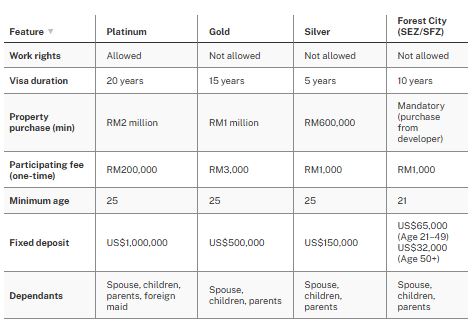
Under the current “MM2H 3.0” framework, applicants are grouped into the three main tiers – Silver, Gold and Platinum – with higher financial thresholds as you move up.
Under published One Stop Centre (OSC MM2H) terms updated on Jul 22, 2024, the tiers come with fixed-deposit requirements and residential property purchase requirements (with minimum values by tier), along with minimum-stay conditions. Offshore income requirements were dropped
The price of entry
MM2H tiers compared
GRAPHIC: hyrie rahmat, bt
Screening has also been tightened. In a written parliamentary reply in late 2025, the government said MM2H applications are now subject to stricter vetting, including police screening and cross-checks with the relevant agencies, as well as a requirement for applicants to submit a letter of good conduct from their home country.
In a separate written parliamentary reply, Tiong said Motac received 3,019 MM2H applications from October 2024 to June 2025: 48 for Platinum, 137 for Gold, 2,434 for Silver and 400 under the Special Economic Zone and Special Financial Zone (SEZ/SFZ) category.
The pattern reinforces MM2H consultants’ view that the scheme is functioning more as a property-linked long-stay visa than a magnet for ultra-wealthy global investors.
States have also marketed their own angles to MM2H applicants. Johor’s Forest City has its special-zone track, while Penang has promoted itself as a lifestyle and healthcare base. Other states, including Melaka, have highlighted mixes of heritage, coastal living and lower costs.
Rules, risks and reality
Before the 2020 suspension, MM2H approvals were less concentrated by nationality. The revamped tiered structure has filtered for wealth, but the latest split suggests it has not meaningfully diversified the programme’s source markets.
As regional peers compete more aggressively for globally mobile families, Malaysia faces a strategic choice: position MM2H as a credible long-stay platform – or accept a narrower niche.
That tension is clearest in Johor’s Forest City, which has its own MM2H-linked category with a lower fixed deposit and a longer visa term than national Silver, but ties eligibility to buying directly from participating developers.
Forest City’s special MM2H tier
Under published OSC MM2H terms, the difference is clear. National Silver requires a fixed deposit of US$150,000 for a renewable five-year visa.
The SEZ/SFZ category associated with Forest City requires US$65,000 (ages 21 to 49) or US$32,000 (aged 50 and above) and grants a renewable 10-year visa. The minimum age is also 21, versus 25 for the main national tiers, widening the pool beyond retirees to younger applicants and families.
The trade-off is that applicants must buy directly from developers, and the property cannot be sold for at least 10 years. Industry advisers say the SEZ/SFZ MM2H track is now closely associated with Forest City.
Association figures show the Forest City SFZ category has 502 principal applicants and 792 dependants (1,294 people) – about 9.5 per cent of total MM2H participants. While small compared with Silver, agents said it gives Forest City a steadier base of long-stay households to support retail and services.
Peter (not his real name), a trader from the US in his early 60s who lives in Forest City under MM2H, fits the programme’s target profile – financially independent and drawn to Johor’s proximity to Singapore.
“It used to feel very secluded, which suited my trading routine. But lately, there are more activities and people around than when I first arrived,” he said.
The Forest City track sits alongside Johor’s Johor-Singapore Special Economic Zone (JS-SEZ) push, as Malaysia bets on a “twin-city” future enabled by improving transport links.
The RTS Link is targeted to begin passenger service by December 2026, with the Bukit Chagar-Woodlands North journey expected to take about five minutes. Forest City is not directly served by the RTS, but better Johor-Singapore connectivity could still lift the wider region’s appeal for cross-border professionals.
Education and family offices
Despite the higher financial thresholds, industry players say schooling is becoming a key – and growing – driver of MM2H interest, alongside traditional retirement demand.
Agents echoed Liew’s point about applicants who come for their children’s education.
Lai said that in some cases, only the mother stays with the child and this “study mother” group tends to cluster around international schools, including Forest City International School and Marlborough College Malaysia.
Under the current rules, participants can withdraw up to 50 per cent of their fixed deposit, subject to approval, for purposes such as education, which makes it easier for families to use MM2H while funding school fees.
Beyond education, wealthy families can also access Malaysia’s Single Family Office scheme.
Launched in September 2024 and gazetted in October 2025, the Forest City-based framework offers a zero per cent tax rate for up to 20 years (10+10) for funds managing at least RM30 million.
Securities Commission Malaysia has granted conditional approval to six families so far, with indicative assets under management of nearly RM400 million.
The new buyer profile
Lai said she is seeing buyer interest broaden in her inquiries compared with pre-pandemic years.
“Before Covid, there used to be many Chinese nationals making inquiries and purchases, but the scenario is different now,” she said. “Most of the people I see coming in now are from Singapore, the US, Norway, France and Taiwan.”
Singaporeans are part of the mix, although they remain a small slice of overall MM2H pass holders.
In an Oct 16, 2025, parliamentary reply, Tiong said Singapore nationals accounted for 184 of the 5,972 foreigners holding MM2H passes (principals and dependants) as at Aug 31.
For this group, Johor’s proximity can make MM2H less about relocating and more about flexibility – a weekend base, a semi-retirement option, or a family base that stays tied to cross-border life.
“A Singaporean client bought one of the villas here several months ago,” Lai said, adding: “He is a retiree who loves to play golf, so he bought it as a weekend home, spending a little over S$400,000.”
Source: https://www.businesstimes.com.sg