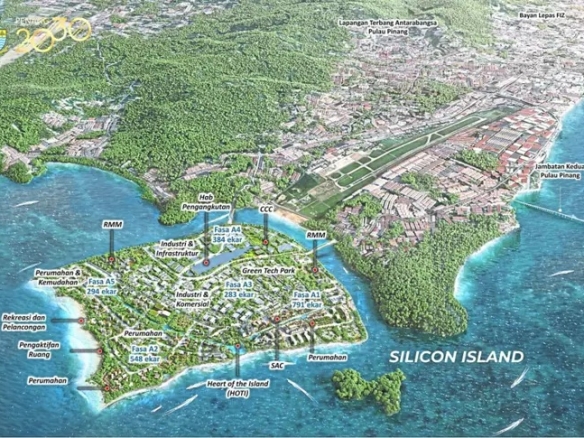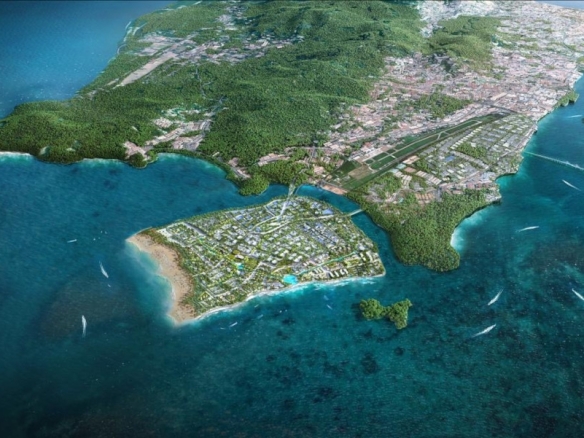

Applicants in the special zones can only purchase property within the Forest City mega development (Photo by Sam Fong/The Edge)
This article first appeared in The Edge Malaysia Weekly on September 15, 2025 – September 21, 2025
MALAYSIA’s long-term residency visa scheme aimed at attracting wealthy foreigners to make the country their “second home” is finally getting back on track after multiple overhauls.
Now, nearly a year since the latest iteration of the Malaysia My Second Home (MM2H 2024) programme was relaunched, foreigners and long-term tourists who had chosen to wait until they obtained further clarity are returning — though application numbers remain well below the levels seen in earlier versions.
Anthony Liew Yong Huat, president of the Malaysia My Second Home Consultants Association (MM2HCA), says the programme has gained traction over the past year as confusion over specific details of the new policy has been cleared up.
There was some uncertainty on whether applicants needed to purchase a property before applying for MM2H, or after securing approval, as there was a risk of rejection after buying a property.
“Response to the latest MM2H is better than the earlier version, known as eMM2H, launched in August 2021. But to be fair, eMM2H was introduced during the Covid-19 pandemic,” Liew tells The Edge in an interview.
Malaysia had tightened requirements for long-term residency under the eMM2H scheme, including raising the minimum fixed deposit (FD) amount to RM1 million. Previously, applicants aged 50 and above needed to have RM150,000 in their account, while those under 50 required RM300,000. The minimum offshore income requirement also quadrupled, from RM10,000 to RM40,000 per month.
he programme recorded 1,905 approved applications between November 2021 and end-September 2023.
In comparison, official statistics show that as at June 30, 2025, a total of 3,019 applications had been received since October 2024, when the Ministry of Tourism, Arts and Culture (Motac) relaunched the revamped MM2H programme. Of these, 1,294 applicants have been granted endorsement passes.

This is despite MM2H 2024 requiring applicants to place at least US$150,000 (RM631,000) in an FD account, as well as purchase property in Malaysia valued between RM600,000 and RM2 million, depending on the visa category and region, and hold it for at least 10 years.
“The required spending is actually higher than before. But for those who genuinely want to live in Malaysia and are prepared to buy property, it doesn’t seem to be a major obstacle.
“For those who don’t intend to purchase property, the programme may be less attractive. That’s why we’re seeing fewer applications from countries like Japan and South Korea,” says Liew.
He notes that there are also applicants from the US and European countries, many of whom are actually Asians who had emigrated and are now looking to return to Asia.
“They include former Hong Kongers, Taiwanese or Chinese nationals who are drawn to Malaysia’s multicultural society and lower cost of living. These applicants may not be retired yet but are planning ahead. Concerned that the rules might change again and become stricter, they are acting quickly,” he adds.
For the past four years, MM2H had been in constant flux. The programme had undergone several revisions since its one-year suspension during the Covid-19 pandemic, which was prompted by concerns over alleged abuse in its administration. As at end-2019, before the suspension, 48,471 people held MM2H visas, with Chinese nationals accounting for one-third of the total, according to Motac data.
The stricter rules introduced under the eMM2H scheme followed the government’s decision to attract applicants who are “truly genuine, of high quality, and can positively impact the economy”.
However, these tougher requirements significantly dampened interest in the scheme, according to Liew.
Under relaxed eligibility rules, MM2H 2024 has three categories: silver, gold and platinum, along with a special category for special economic zone (SEZ) and special financial zone (SFZ).
Liew points out that the silver category is currently the most popular among applicants due to its lower entry requirements, which only require purchasing a property worth at least RM600,000 in Malaysia. This is followed by the special zone tiers, which have the lowest FD and renewal fee requirements. However, applicants in the special zones can only purchase property within the Forest City mega development in Johor.
“While it has the highest requirements, including purchasing property valued at a minimum of RM2 million, the platinum category is more suitable for those looking to invest or work in Malaysia,” he adds.
The platinum visa also offers the longest validity period of 20 years, compared to just five years for the silver category.
This is reflected in the 3,019 applications received by Motac, with 2,434 reportedly under the silver category, 400 under the SEZ/SFZ category, 137 under gold, and 48 under platinum.
Property sector biggest winner of MM2H
The property sector is benefiting as MM2H 2024 gains traction. Liew says the mandatory property purchase requirement has supported the local property market.
“The government’s main objective in revamping MM2H was to attract high-net-worth individuals (HNWIs). I believe they are achieving this through the mandatory property purchase and financial requirements, which help boost the Malaysian economy. However, the numbers may not yet be substantial,” he adds, noting that 2017 was a record year for MM2H approvals, with 6,195.
Chinese nationals remain the largest group of MM2H participants, accounting for almost half of the total, followed by applicants from Taiwan, Hong Kong, Singapore and the US, Liew says.
“Chinese nationals are attracted to Malaysia for three main reasons: first, the availability of private and international schools; second, relocation opportunities, as some feel pressured in China and want to move their whole family here; and third, as a backup plan,” he explains.
Tourism, Arts and Culture Minister Datuk Seri Tiong King Sing was reported as saying that the new MM2H programme has generated RM839.9 million in revenue, including RM597.5 million in FD investments, RM237.2 million in property investments, and RM5.2 million in participation fees. He added that the programme’s economic spillover also boosts sectors such as education, healthcare, and insurance services.
Samuel Tan, founder and CEO of Johor-based Olive Tree Property Consultants, says he is seeing a significant return of applicants for MM2H 2024, driven by recent policy reforms and Malaysia’s enduring appeal as a lifestyle destination.
“The programme has attracted a diverse range of participants, including retirees, families, digital nomads and investors, primarily from Asia but with growing global interest,” he says in an email reply to The Edge.
“Traditionally, the top applicants were from China, Japan and Bangladesh. Currently, Chinese applicants remain significant; the relaxed policies, such as lower financial thresholds, are attracting broader interest from Singaporeans. They are drawn by proximity, affordability and the Johor-Singapore Special Economic Zone (JS-SEZ) category, which focuses on Johor’s Forest City. Other Asian countries include Japan, South Korea and Southeast Asian nations,” he adds.
The programme has also attracted Western expatriates, including retirees and digital nomads from Europe and North America who are seeking affordable tropical living, says Tan.
However, he points out that the mandatory property purchase requirement deters a significant number of potential MM2H applicants, particularly retirees and middle-income individuals.
“MM2H processing agencies have observed a dramatic loss of interest. For example, one agency reported that out of over 500 initially interested applicants, fewer than 50 remained after the new rules were announced. Only 30% to 40% of current MM2H holders are inclined to purchase property under these new conditions, indicating the requirement is a major ‘deal breaker’,” he explains.
He adds that the removal of the monthly offshore income requirement (previously RM40,000) does not offset the burden of the large, illiquid property investment.
“While the government intended to boost the property market, economists argue the rules may be too restrictive to be effective. The requirement risks reducing overall applicant numbers without significantly [boosting] property demand,” he says, noting that the estimated economic loss was around RM9 billion (US$2.16 billion) between 2020 and 2023 due to reduced participation.
Tan highlights that the revised MM2H now explicitly targets HNWIs through its tiered system. This strategic shift aims to boost foreign investment but inevitably excludes a broad segment of former applicants.

Olive Tree’s Tan thinks MM2H visa holders should be allowed to work in sectors where there is a lack of local talent. This will grow the economy, without compromising the job opportunities of locals. (Photo by Low Yen Yeing/The Edge)
“While aimed at attracting wealthier investors and stimulating the property market, the policy has instead driven potential applicants to more flexible and affordable programmes in neighbouring countries. For MM2H to regain its former popularity, Malaysia may need to reconsider the mandatory property clause or introduce more flexible investment options to accommodate a wider range of applicants,” he says.
He also notes that MM2H holders under the SEZ/SFZ category cannot work or be employed locally in Malaysia. However, they can own businesses but must apply separately for relevant licences and permits. Businesses in sectors aligned with JS-SEZ and the Forest City SFZ priorities include financial services and technology, though they must adhere to foreign ownership rules and regulatory requirements.
“We opine that MM2H visa holders should be allowed to work in sectors where there is a lack of local talent. This will grow our economy, without compromising the job opportunities of locals. To future-proof, our locals should be reskilled or upskilled,” says Tan.
S-MM2H sees rising interest
While the federal government paused, revamped and reintroduced its MM2H programme for Peninsular Malaysia, Sarawak launched its own state-specific long-term residency visa in September 2020.
The Sarawak-Malaysia My Second Home (S-MM2H) programme was relaunched with new rules in January this year. Key changes include increased financial requirements: single applicants must now place RM500,000 in an FD account in Sarawak (compared to RM150,000 previously) and RM300,000 for couples.
Applicants must also demonstrate liquid savings of RM100,000 per year (RM200,000 for couples), or income in the form of monthly offshore income, government-approved pension funds, or rental income of RM10,000 for individuals and RM15,000 for couples — up from the previous RM7,000 and RM10,000 respectively.

Chai says Aramaz Borneo’s top five applicant groups are from the US, the UK, Australia, Singapore and Japan (Photo by Teresa Chai)
S-MM2H applications have slowly picked up, with an estimated 150 cases submitted year to date and approval rate of over 95%, according to Teresa Chai, director of Kuching-based Aramaz Borneo (S-MM2H) Sdn Bhd.
Last year, more than 500 cases were approved under the Sarawak programme. “Bear in mind though, Peninsular Malaysia’s MM2H programme was only officially relaunched in October. At that time, we had the bulk of the numbers because there were no other options,” she tells The Edge.
“While the liquid assets and monthly offshore income requirements are manageable, the RM500,000 FD could be seen as a hindrance for some. By comparison, Peninsular Malaysia’s MM2H requires only US$150,000 for the silver category,” she adds.
“This led to a slowdown in applications during the early months of this year. From June onwards, numbers gradually increased as applicants realised there is now a variety of MM2H programmes — four categories in Peninsular Malaysia, three in Sabah, and one in Sarawak — to choose from. Our (S-MM2H) strongest selling point is that we do not require applicants to purchase property.”
Additionally, the minimum stay period in Sarawak is just 30 days a year compared with 90 days in Peninsular Malaysia.
The S-MM2H programme has also been simplified into a single category for all applicants aged 30 and above. Previously, there were two age categories: 30 to 49 and 50 and above.
Chai says for Aramaz, the top five applicant groups are from the US, UK, Australia, Singapore and Japan.
“They like Malaysia’s year-round summer, the ability to stretch their dollars, euros or other currencies, and the relatively low cost of living compared to other Southeast Asian cities. Additionally, Malaysia’s security, friendly people, culture and food are big draws,” she says.
The approval process for S-MM2H has also sped up considerably. Previously, approvals could take 12 to 14 months. Last year, approvals took five to six months. By the fourth quarter of 2024, approval times had been reduced to three to five months, depending on the application.
Meanwhile, S-MM2H participants are allowed to work, but only after visa approval and with special permission from the Premier’s Office. Work is limited to 20 hours per week and confined to industries where there is a talent shortage, such as heavy engineering, and oil and gas.
Sabah-MM2H
As for Sabah, the state parted ways with Peninsular Malaysia’s MM2H programme and launched its own long-stay visa scheme on June 30, 2024, due to differences over Motac’s directive in May 2024 for all licensed agents handling MM2H applications, including those in Sabah and Sarawak, to cease operations. However, it is understood that Sabah-MM2H is less appealing due to similar requirements as the peninsula version, notably the condition on mandatory property purchase.